
UAE 6G Trial: Record 145 Gbps Terahertz Pilot by e& & NYU Abu Dhabi
The United Arab Emirates has once again proven its dominance in global technology innovation with a groundbreaking 6G trial that hit an unprecedented 145 Gbps. Conducted by e& in collaboration with NYU Abu Dhabi, this historic Terahertz pilot marks the first of its kind in the Middle East—paving the way for next-generation network infrastructure, AI-driven connectivity, and ultra-low latency performance. More than just speed, this achievement defines the future of digital transformation in Dubai, positioning the UAE at the forefront of the global race toward the 6G era.
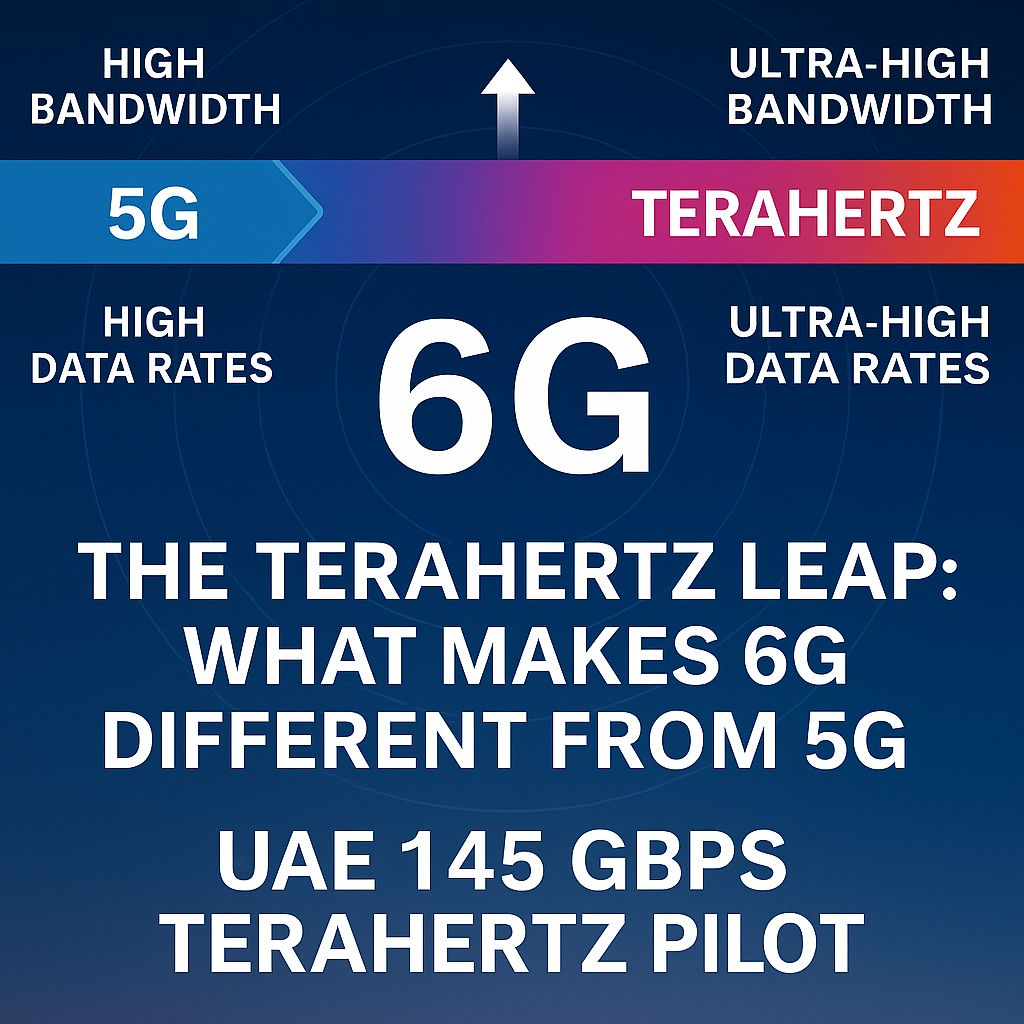
The Terahertz Leap: What Makes 6G Different from 5G
In the race from 5G to 6G, the defining shift isn’t just speed — it’s the switch to terahertz (THz) spectrum. While 5G pulled off gigabit-class downloads, 6G is engineered for hundreds of gigabits or even terabits per second, enabled through the ultra-wide THz band (0.1–10 THz). This transition empowers entirely new applications — from holographic calls to instant VR worlds — that were impossible on legacy networks. The UAE’s 145 Gbps THz pilot by e& and NYU Abu Dhabi underscores how the nation is not only keeping pace but leading the global 6G wave, positioning Dubai as a hub for future-proof network infrastructure.

Infrastructure Overhaul: Building the Backbone for 6G
Achieving 6G-class speeds demands far more than just new radio waves — it requires a complete re-engineering of network infrastructure: ultra-dense micro-cells, high-capacity fiber backhaul, edge data centres, and AI-controlled network fabrics. In Dubai, the 145 Gbps pilot captures exactly this shift — underpinning how the UAE is building a terabit-ready backbone to support next-gen services like AR/VR, intelligent industry & smart cities. For integrators like CALLIT IT INFRASTRUCTURE, this means now is the time to lead with future-proof fibre, switching, and edge-build services.

Use-Cases Unleashed: From Holograms to AI-Native Networks
What separates 6G from its predecessors isn’t just faster data — it’s new experiences and intelligent networks. With the UAE’s terahertz pilot achieving 145 Gbps, we’re looking at lifelike holographic conferencing, immersive digital twins in real-time, and AI-native network fabrics that self-optimize and self-heal. These services will demand ultra-low latency, massive device density, and distributed compute at the edge — features central to CALLIT’s roadmap for delivering future-ready enterprise solutions.

Challenges & Realities: What’s Next for UAE’s 6G Rollout
While the 145 Gbps THz pilot is a headline milestone, real-world 6G rollout faces major challenges: propagation limits of THz waves, device manufacturing, spectrum allocation, and infrastructure cost. Dubai’s environment offers an ideal testing ground, yet full commercial deployment will require years of ecosystem build-out and standards development. For CALLIT, this means advising clients on strategic migration paths — from 400 GbE upgrades today to terabit-capable networks tomorrow — ensuring their infrastructure is ready when 6G goes live globally.
